
Johnson County Criminal Court Records
A criminal court record is the case-level file kept by the court after charges are filed. In Johnson County, those records can be tied to the Johnson Circuit Court, Johnson Superior Courts, Greenwood City Court, or Franklin City Court depending on the offense level, citation, ordinance issue, or misdemeanor venue. The Clerk of the Courts is the copy and official-record fallback for Circuit and Superior Court filings that do not appear as linked documents in MyCase.
The criminal case file is broader than the charge list. It can include the prosecutor's charging information, probable cause material when public, initial hearing records, bond entries, plea agreements, trial settings, motions, court orders, sentencing entries, probation conditions, restitution, and final judgments. For the narrower arrest-to-charge path, use Johnson County arrest records and court charges, where booking information and filed charge status are separated from the full case outcome.
Indiana Code title 35 is the state law source for criminal procedure and expungement material used with Johnson County criminal court records.
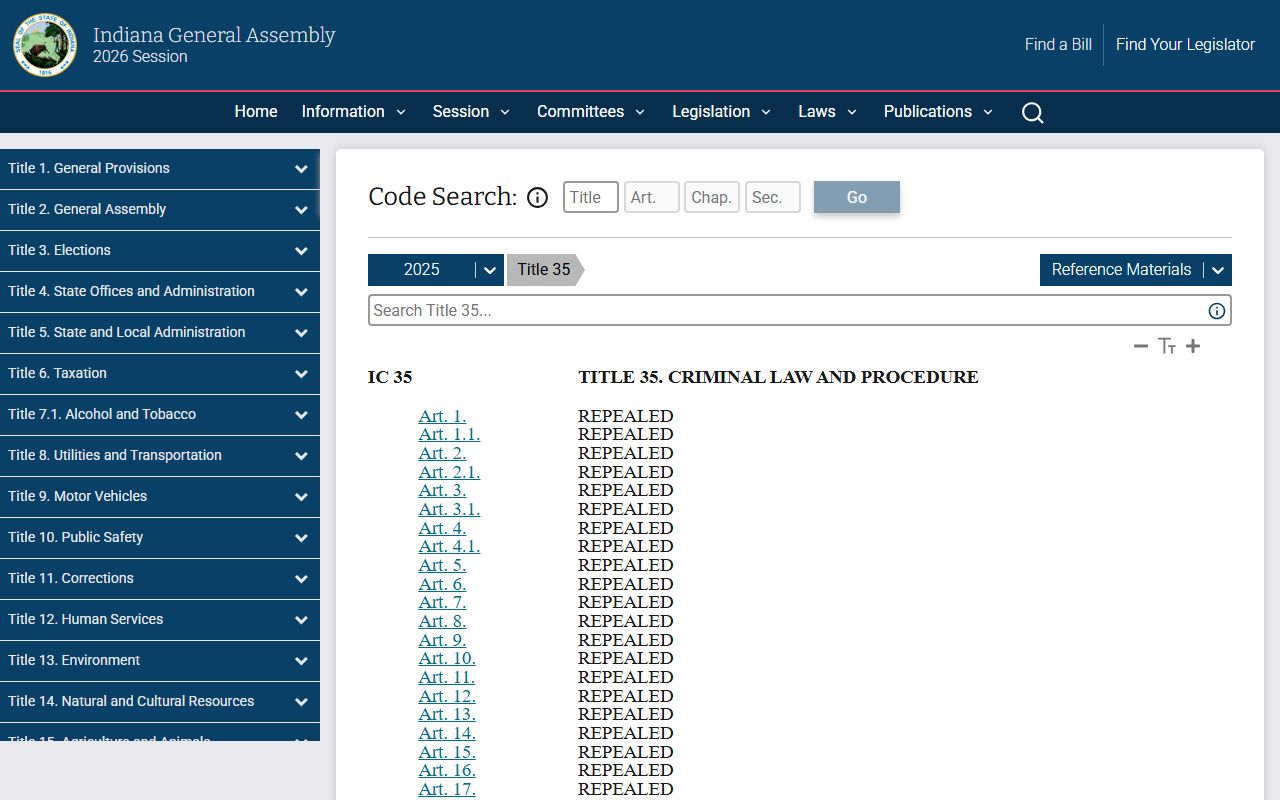
That state-law source is most useful when a docket entry refers to criminal procedure, sealing, expungement, or post-conviction terms.
Search Johnson County Criminal Court Records
Use Indiana MyCase for public Johnson County criminal case information. MyCase is statewide, so a name search should be narrowed by county or court when possible. A case number is the strongest search key. If a defendant is in jail but no court case appears, the arrest may not yet have produced a filed case, the search terms may be incomplete, or the record may be restricted.
- Open MyCase and choose the public case-search service.
- Search by defendant name, case number, attorney, court, county, or date range.
- Filter to Johnson County or the specific local court if the portal offers that field.
- Open the case and review the CCS for charges, hearings, motions, orders, disposition, sentence, and bond events.
- Request a certified copy from the Johnson County Clerk if the needed criminal document is not linked online.
MyCase help says final orders and judgments in criminal cases are among public document types available online, while some documents are not linked. The absence of a document link does not always mean the document is confidential. It may simply require a clerk request. Broader Johnson County court records include civil, family, probate, traffic, and other case types beyond criminal files.
Johnson County Criminal Case Flow
A criminal case moves through several stages, and each stage can create a docket entry or document. The charge starts the case, but the final record may tell a more complex story. A charge can be amended, a bond can change, a hearing can be continued, a plea can resolve only some counts, and sentencing can include jail, probation, restitution, program conditions, or costs.
Case flow: Charges Filed › Initial Hearing or Arraignment › Pretrial and Motions › Plea or Trial › Disposition › Sentencing
| Stage | What Happens |
|---|---|
| Charges filed | The prosecutor files the formal accusation, commonly by information in Indiana state court. |
| Initial hearing or arraignment | The court addresses rights, charges, plea posture, counsel, release conditions, and bond where applicable. |
| Pretrial and motions | Parties file requests, notices, discovery items, continuances, suppression issues, or plea discussions. |
| Plea or trial | The defendant resolves the case by plea, bench trial, jury trial, dismissal, or other court action. |
| Disposition | The court records the result of each charge, claim, or count. |
| Sentencing | The court enters jail, probation, fines, costs, restitution, program, or other legal consequences after conviction. |
What Johnson County Criminal Records Show
Criminal court records should be read by charge and by case status. A single Johnson County case can have several counts, and each count may end differently. The court record may show the original charge, an amended or reduced charge, a dismissal, a plea, a trial result, or a sentence. The CCS can also show bond, warrant, no-contact, probation, and payment entries when public.
| Field | What It Shows |
|---|---|
| Case number | The cause number used in MyCase, court notices, warrants, and clerk copy requests. |
| Defendant | The person charged, subject to public-access rules and redaction. |
| Court | The Johnson Circuit Court, Johnson Superior Court, Greenwood City Court, Franklin City Court, or appellate court tied to the case. |
| Charges | The offense names, levels, counts, and changes made through the case. |
| Hearings | Initial hearing, pretrial, trial, plea, sentencing, review, and other public settings. |
| Plea | The defendant's answer or plea agreement posture when public. |
| Disposition | The result for the case or each count, such as guilty, dismissed, acquitted, or transferred. |
| Sentence | Jail, probation, fine, cost, restitution, treatment, program, or other imposed condition. |
| Document links | Public online documents when MyCase makes the document type available. |
Johnson County Prosecutor Role
Indiana uses prosecuting attorneys, not district attorneys. In Johnson County, the prosecutor is the office that decides what criminal charges to file after law enforcement submits an arrest or investigation. The research source names Lance D. Hamner as Johnson County Prosecutor and lists the office at 1 Caisson Drive in Franklin, with jcpofrontdesk@co.johnson.in.us and (317) 346-4525.
The prosecutor's filing decision is important because an arrest does not always equal a filed criminal case. A booking entry can exist before formal charges appear in MyCase. Once charges are filed, the court record begins tracking the charge, first hearing, motions, plea or trial events, disposition, and sentencing. For Franklin City Court traffic deferral questions, the sheriff traffic-ticket page routes users to the prosecutor's phone number.
The Indiana Prosecuting Attorneys Council profile is the source for Johnson County prosecutor information.
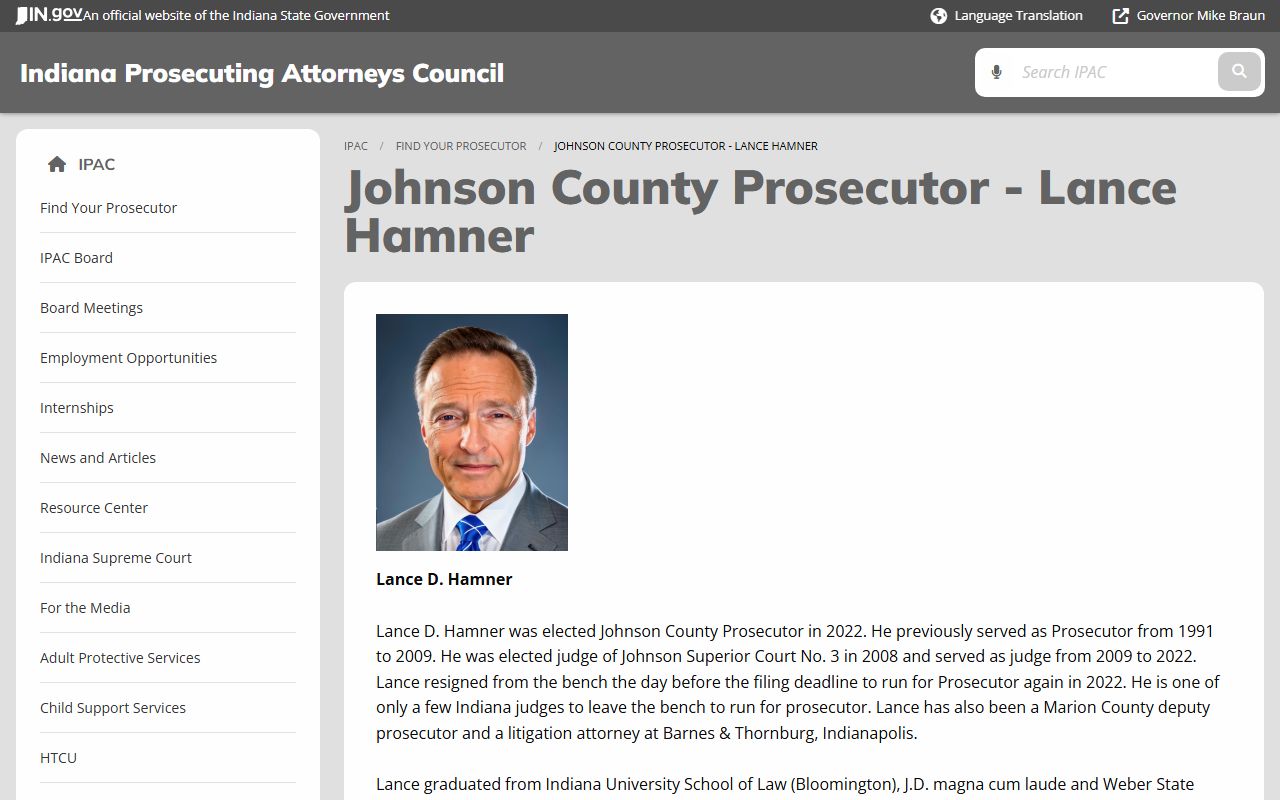
That source helps separate police arrest activity from the prosecutor's formal charging role in Johnson County criminal cases.
Charges vs Convictions
A charge is an accusation filed in court. A conviction is a final result after a guilty plea, finding, or verdict. Johnson County criminal court records may show charges that were dismissed, reduced, amended, or resolved with different outcomes by count. A search result should not be read as a conviction unless the disposition or judgment actually supports that conclusion.
| Point | Charge | Conviction |
|---|---|---|
| Meaning | An accusation filed by the prosecutor. | A final guilty result by plea, verdict, or finding. |
| Record stage | Appears early in the criminal case. | Appears after disposition and judgment. |
| Can change | May be amended, reduced, dropped, or dismissed. | May be appealed, corrected, sealed, or expunged if eligible. |
| How to verify | Read the charge list and CCS entries. | Read the disposition, judgment, and sentencing entries. |
Sealed vs Expunged Criminal Records
Public access ends where a statute, court rule, or order excludes the record. MyCase help says public search covers cases that are not confidential, not sealed, and not expunged. In Johnson County, expungement petitions under IC 35-38-9 are filed in the circuit or superior court tied to the charges, or in the county where the arrest occurred if no charges were filed.
| Point | Sealed | Expunged |
|---|---|---|
| Public visibility | Hidden or restricted from ordinary public access. | Restricted under Indiana expungement law when an order is granted. |
| How it happens | By statute, rule, or court order. | By petition and court order under the relevant IC 35-38-9 section. |
| Key detail | Some government access may remain. | Eligibility depends on charge, disposition, timing, and statutory criteria. |
Public Access to Johnson County Criminal Records
Johnson County criminal court records follow the Indiana Rules on Access to Court Records and Indiana public-records law. Public access is the default for court records unless a rule, statute, or court order excludes the case, document, or field. Rule 5 lists excluded records and sensitive information. Juvenile court and law-enforcement records are confidential except as provided by statute, so juvenile delinquency should not be treated like an ordinary adult criminal case.
Protection orders use a separate public search path. MyCase help says protection-order cases cannot be found on MyCase because the protected person's name and certain identifying information are excluded from online public access. Indiana's protection-order system sends electronic entries to law-enforcement systems when orders are issued, modified, or revoked.
The Indiana Protection Order Registry page explains the separate protection-order process outside ordinary MyCase criminal lookup.
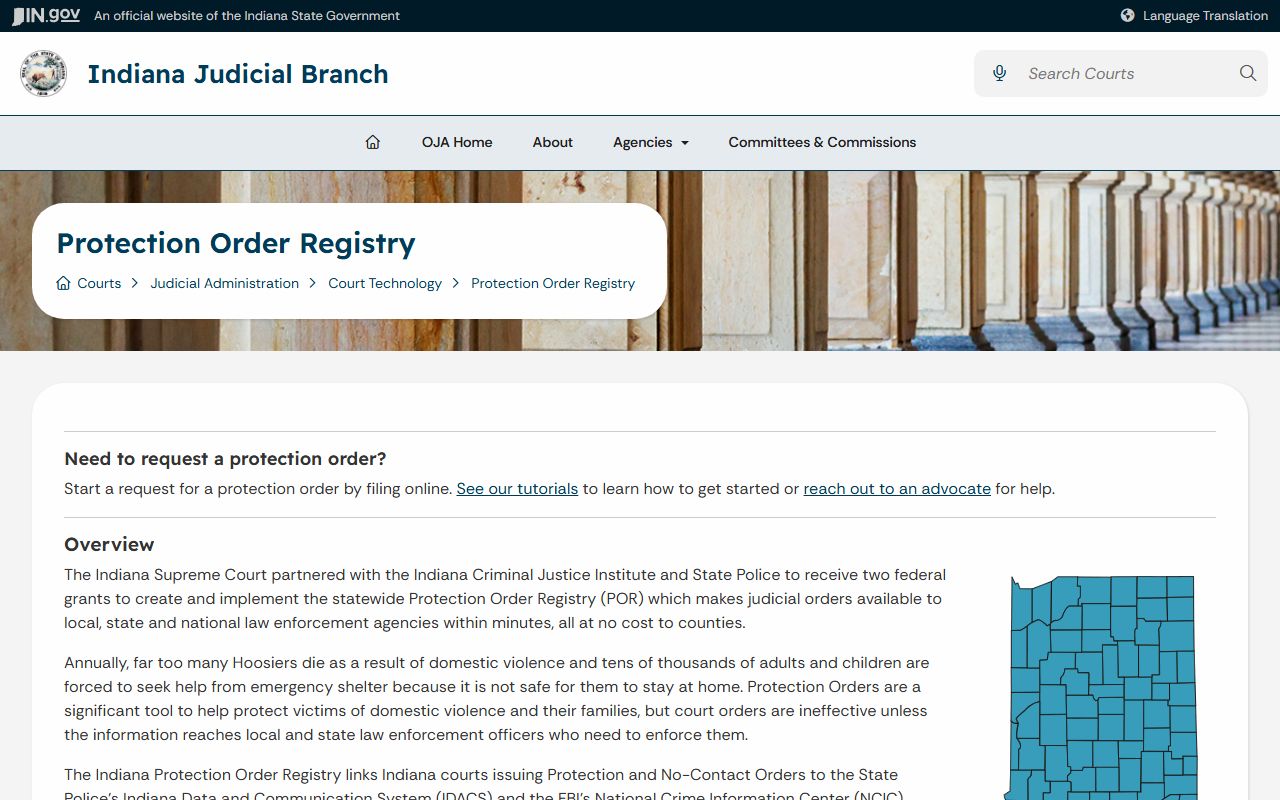
That separate registry matters when a Johnson County criminal case includes no-contact or protection-order issues.
Public Defender and Counsel Route
For pending state-court trial, sentencing, and direct appeal matters, the Indiana State Public Defender page says to contact the public defender office in the county where charges were filed. If the county does not have a public defender office, contact the court where the person has been charged. Johnson County research did not locate a separate county public defender office page, so indigent-defense questions should route to the court handling the case unless a newer official county page gives a direct office.
Federal criminal cases are different. Johnson County state criminal court records are not federal records, and federal defense channels follow the Southern District of Indiana system. Post-conviction relief after conviction can involve the State Public Defender rather than the trial-level court contact. The court record itself should be checked first so the correct case number, court, charge, and sentence are clear.
The Indiana State Public Defender source explains county-level contacts for pending trial, sentencing, and direct appeal matters.
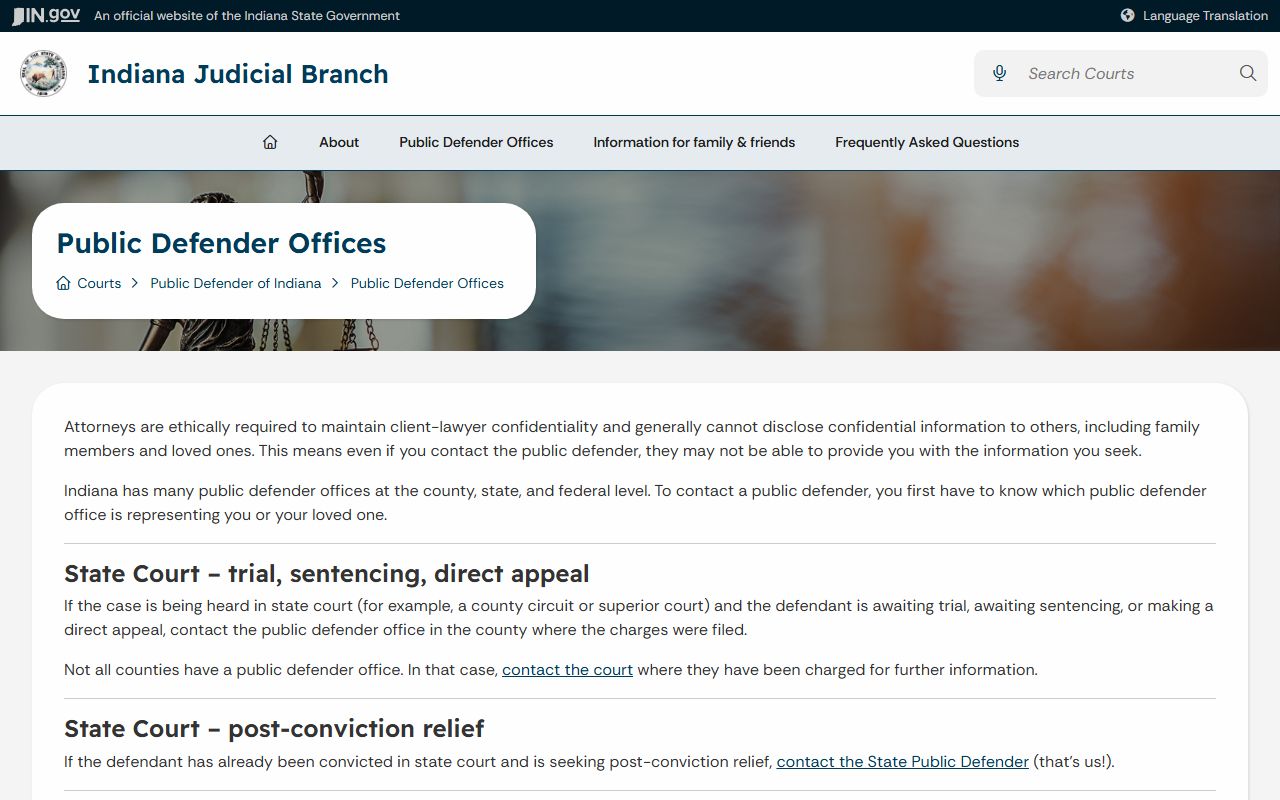
That guidance is useful when the criminal court record shows an active charge and the person needs the correct defense contact path.
Restricted Johnson County Criminal Records
Restricted criminal records include juvenile matters, sealed or expunged adult matters, some mental-health or treatment information, protected identifiers, and documents withheld by rule or order. An online search may show a public case without showing every document. It may also show no case at all when the matter is confidential or has been sealed.
For official copies, contact the Clerk of the Courts with the case number, defendant name, record requested, and certification need. For jail custody or booking information, use the jail roster or sheriff channels. For law-enforcement incident reports and crash reports, use the sheriff's Records Division rather than the criminal court case file.